- Youth & Startups
What’s the deal?
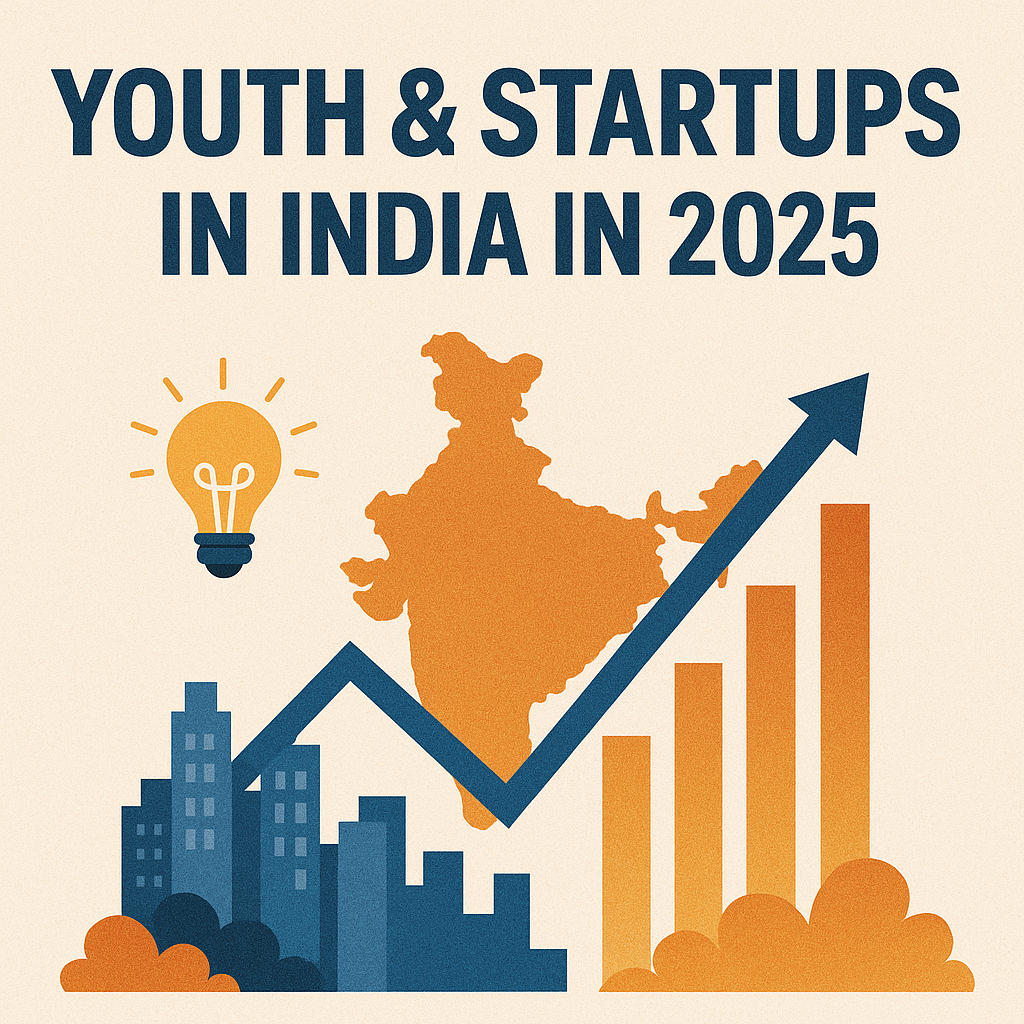
One major plus for India is its youthful population. More and more, they’re getting into startups, new ideas, and tech businesses. The government and other groups are helping out, and investors from around the world are showing interest too.
What happened in 2025?
According to India Today, the Indian startup scene is abuzz. It houses more than 415,000 startups, of which around 75,000 are run by women, and is growing fast-about 12 to 15% every year-with over 117 becoming unicorns worth over $1 billion.
Startups are collaborating across borders, such as how Startup Flight 2025 in India emphasized tech and startup collaboration between India and Vietnam.
- Investors are still interested, but they’re being careful. Startups in India raised about $4.8 billion in the first half of 2025-down about 25% from last year. They raised about $2.1 billion across about 240 deals in the third quarter, down 38% from the same time in 2024.
Programmes to encourage innovation in the minds of young thinkers are also part of the policies. For instance, Samsung’s Solve for Tomorrow 2025 gave money (INR 1 crore each) to young inventors at IIT Delhi.
- CM YUVA Conclave & Expo 2025, Lucknow (Uttar Pradesh), saw a registration of around 30,000 youth. About 8,380 potential entrepreneurs attended from the networking meetings.
What it means
More young people starting businesses and getting support means the startup scene is getting more mature. But the drop in funding might mean things are cooling off a bit, maybe because of what’s happening around the world-interest rates, uncertainty-or problems here at home, which is making profit and growing bigger.
Engagements with other countries-the case of Vietnam here-show that India is not only a big market but also a source of new ideas.
Youth programmes in fact prove that India wants startups which, apart from generating money, help society too-for instance, tech for people with vision problems or sports tech-something on the lines of Samsung’s thing.
Still, there are things to consider: growing beyond the early stage, turning ideas into real businesses, making truly new things-not just small changes.
–
- RBI & Government Economic Policy
What’s the deal?
RBIs remain super relevant to monetary functions in India, such as banking policies and keeping inflation at bay, ensuring the steadiness of the monetary system. The governmental monetary policies-curbing unwanted expenditure, balancing the books, and promoting infrastructure development-are also vitally important.
What happened in 2025?
The RBI report 2024–25 projects that the Indian economy would fare well during 2025–26 on grounds of re-spending by people, spending by the government on stuff, and on account of the good money situation.
People at the summit said that the way India has kept its inflation in check-a task cut out for the Monetary Policy Committee-has mostly worked and didn’t need big changes.
What it means
The good economic outlook is encouraging. It is good for the young and startups: people buying more stuff means a bigger market; spending on infrastructure translates, maybe, to more demand for services and technologies.
The stability of the inflation policy is reassuring for investors.
But there are warnings like global problems, and issues here at home-like not enough skilled workers and complicated logistics.
The Government is pushing infrastructure, manufacturing, online payments— sectors that can kick-start startup chances, hiring, and doing business with the world.
- Government and Recruitment
What’s the deal?
The government is still a means in which youth seek employment. The government shapes job training, job creation, and changes in the way things are done.
What happened in 2025?
Some of the changes made by the Staff Selection Commission include computer-based exams, abolition of interviews, and speeding up of hiring from 15-18 months to 6-10 months.
The RRBs said that more than 9,000 jobs were given out and that by the end of this year, they were planning to hire 50,000+.
More than 51,000 job offers were distributed at 47 places during the Rozgar Mela 2025 event.
The RBI announced 120 openings for officers in 2025.
What it means
Thus, the government is trying to lower unemployment and hire graduates, making the recruitment process easier.
Changes like online exams and speedier hiring reduce stress and help eliminate backlogs. It basically means that for a young person, it is an easier path to a government job.
But more government hiring might mean the private sector is not hiring enough skilled young people.
For startups, it could be a problem: if young people find government jobs, fewer of them will create their own businesses. But government jobs provide stability, so the overall probability of employment rises.
- Terrorism & National Security
What’s the deal?
National security is considered a concern in India due to terrorism, internal conflicts, radical ideas, the movement of money and weapons through illegal means. India is working on domestic policing, changing the laws, and working with other countries.
What happened in 2025?
The NIA conducted raids in multiple states over a terror plot linked to ISIS, among other groups.
The government advocated teamwork with other nations. India called for the United Nations Security Council to have zero tolerance for terror financing and illegal weapons.
The government replaced old laws with new criminal laws including dealing with fugitives.
What it means
More counter-terror stuff shows that the danger is real and that India is disrupting terror networks more.
Changes in the law show India’s plan is changing: from policing to bigger changes-legislation and extradition.
A safe internal-security place is a must for businesses. Terror stuff hurts confidence, redirects resources, and makes security more expensive.
India’s actions demonstrate how it sees itself as a responsible security player on the world stage.
- India on the Global Stage
What’s the catch?
India is becoming a global player in trade, working with other countries, tech, security, and helping the world. Its young people, startups, and the economic boost this.
What happened in 2025?
India’s push for zero tolerance on terror financing at the UNSC marks its role in global security.
Startup teamwork with other countries-let’s say Vietnam-shows that India is reaching out in tech and new ideas.
The good economic view and stable money policy help the credit of India with global markets.
As India makes itself stronger-through economy, new ideas, and security-it can impact the world.
Global things include opportunities to new markets, investment, new people, and collaboration. Businesses that think globally will be the ones doing well at home.
This means that this global role brings with it tensions, like tensions with other countries, and expectations for following the rules on trade, climate, and technology.
Closing the gap between the skills and global ambitions of India: create scale, good institutions, and global competitiveness.
6.Environment, Climate & Disaster Risk
Climate Risk: India Among Top-Affected
With extreme weather impacts between 1995 and 2024, the Germanwatch Climate Risk Index 2026 ranked India at 9th in the world, despite a world record high of extreme climate incidence.
This ranking describes the serious risks in life loss, agricultural/elevation damage and the increase in disaster-response costs.
Cyclone Vulnerability
The recent article discussed why India is becoming increasingly vulnerable to tropical cyclones, for example, the “Severe Cyclonic Storm Montha” in Andhra Pradesh and other states.
The result are climate change at sea surface, coastal urbanisation and failure of infrastructure resilience.
Transition in Clean Industrial Projects
The environmental agenda is the third-largest in India’s clean industrial pipeline.
Clean-industry investments targeting “hard-to-abate” industries, such as steel, cement, chemicals can also reduce emissions and encourage employment/investment.
Significance & Challenges
The high climate risk rating means that India must focus on adaptation, flood resilience, early warning systems and mitigation more heavily.
There are good improvements in clean industry, but only six of the 65 projects have reached FID, so pipeline must go into action.
Ultimately, the collision of disaster risk (cyclones, floods) and growth infrastructure (ports, power) reveals the need for climate smart planning.
Implications
For policy, both mitigation (clean energy and industry), and adaptation (disaster resilience), need to be scaled up.
For economy, climate risk is now material economic risk – insurance, infrastructure damage, agricultural loss – now.
As for society: poorer, coastal/marginal populations are more highly affected by poverty; equity concerns arise.
For global good, India can assume a position as an important player in sustainable growth but it is also required to do so.
7.Conclusion
In 2025 India, has a mixture of opportunities and challenges, as the youth and startup scene is buzzing, yet raising cash is still hard. The RBI and government's help money: people spending more and stable inflation. Reforms in hiring and big hiring efforts show India is trying hard to get young people into jobs. In security, India is sharpening its tools and globally, India is doing more. For India's youth specifically: in the case of business ownership, joining institutions, dealing with talent versus low supply, competition, and risk and regulations related to global money are some of the challenges. But the mission is clear: scale newness, deepen institutions, make India's ecosystem one with global networks, and ensure that young people play a role.Author – Kasak
Leave a Reply